Caller ID masking is defined as the practice of replacing your real phone number with an alternate number on outbound calls, so the recipient sees a different identity than your actual line. The industry standard term is "call masking," and it is the legal, transparent cousin of caller ID spoofing. Spoofing uses fraudulent numbers to deceive; masking is legal when the displayed number is one you own and control. Regulatory bodies like the FCC enforce this distinction through frameworks such as STIR/SHAKEN, which authenticates caller identity at the network level. Carolina Digital Phone builds compliant call masking directly into its hosted VoIP platform, giving North Carolina businesses a dependable way to protect staff numbers without tripping spam filters.
How does caller ID masking work technically and legally?
When you place a call, your carrier transmits caller ID data alongside the voice traffic. Masking replaces that data with a different number you are authorized to display. The distinction that keeps it legal is ownership. Under the Truth in Caller ID Act, transmitting misleading caller ID with intent to defraud or cause harm is a federal offense with penalties up to $10,000 per violation. Displaying a number your business owns and answers is transparent identification, not deception.
A masked call from a compliant system passes STIR/SHAKEN verification and displays with an "A" attestation level, meaning the carrier confirms the caller is authorized to use that number. Calls that fail verification get flagged as "Spam Likely" or are silently dropped.
- Masking: Displays a number you own. Legal, compliant, and passes STIR/SHAKEN.
- Spoofing: Displays a number you do not own. Illegal under federal law and flagged by carriers.
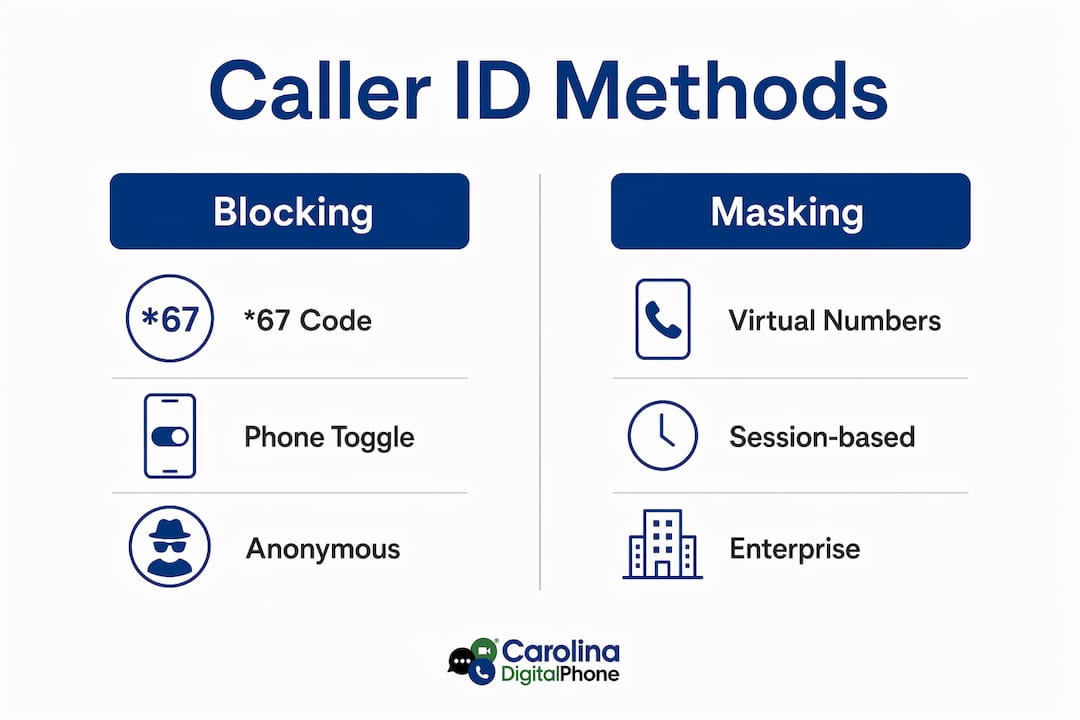
- Blocking: Suppresses your number entirely, displaying "Private" or "Unknown." Legal but increasingly ineffective.
What are the common caller ID masking methods?
Several methods exist for hiding or replacing your caller number, and they differ sharply in how well they work in 2026.
Prefix codes like *67
Dialing *67 before a number blocks your caller ID for that single call. The recipient sees "Private Number" or "No Caller ID" instead of your real number. The limitation is significant: *67 applies only to voice calls and does nothing to hide your identity in SMS. Any text you send from the same number still reveals who you are.
Phone settings toggle
Both iOS and Android let you turn off "Show My Caller ID" in settings, which suppresses your number on every outbound call until you reverse the setting. Permanent suppression via settings applies globally but with network exceptions. Some carriers override the setting and transmit your number anyway, which means the suppression you think is active may not be.
Virtual phone numbers and second-line apps
A virtual number is a real, dialable phone number assigned to you through a VoIP or cloud platform. You make calls from it, and recipients see it as your caller ID. Return calls to that number route back to your actual device. This method covers both calls and texts, making it the most complete form of phone number masking available to individuals and businesses alike.
The effectiveness gap between blocking and masking is real. Modern spam protection apps and built-in features like Apple's "Silence Unknown Callers" automatically route calls marked "Private" or "No Caller ID" to voicemail. That means a blocked call often never rings at all. A virtual number, by contrast, displays a legitimate caller ID and passes spam filters at a much higher rate.
| Method | Covers SMS | Passes spam filters | Carrier override risk |
|---|---|---|---|
| *67 prefix code | No | Low | Yes |
| Phone settings toggle | No | Low | Yes |
| Virtual phone number | Yes | High | No |
How do businesses use caller ID masking to protect privacy and trust?
Businesses use call masking to protect employee personal numbers while still presenting a professional, recognizable identity to customers. The workflow is practical: a cloud platform assigns a company-owned virtual number to each employee or department, outbound calls display that number, and any return call routes back through the platform to the right person.
Business call masking is legal and compliant in 2026 when it transparently identifies the business. The key word is transparently. The displayed number must be one the company owns, and it must be reachable. That structure satisfies FTC requirements and aligns with STIR/SHAKEN authentication standards.
Industries that rely on this approach include:
- Healthcare providers that need to call patients from a clinic number rather than a personal cell, protecting staff privacy while maintaining HIPAA-compliant communication records.
- Delivery and logistics companies that connect drivers with customers through a session number, so neither party ever sees the other's real contact.
- Call centers that display a single branded number regardless of which agent places the call, creating a consistent customer experience.
- Real estate agencies where agents call prospects from an office line, keeping personal numbers private and all call records centralized.
- Legal and financial services firms that need documented, traceable calls without exposing attorney or advisor personal numbers.
The most advanced enterprise approach uses session-based dynamic numbers that are generated per interaction and expire after the call ends. Neither the employee nor the customer retains the other's real number, but the platform logs the full call for compliance purposes. This is the gold standard for caller identity concealment in high-stakes industries.
Showing a legitimate caller ID improves answer rates compared to anonymous blocking. That single fact drives most enterprise adoption. A call from "Unknown" gets ignored. A call from a recognizable business number gets answered.
What practical tips should you follow when implementing call masking?
Choosing the right method depends on what you need to protect and how often you need to protect it.
- Match the method to the use case. Use *67 only for one-off calls where getting through is not critical. Use a virtual number for any ongoing communication where answer rates matter.
- Own the number you display. The displayed number must be registered to you or your organization. Displaying a number you do not control is spoofing, not masking, regardless of intent.
- Test STIR/SHAKEN compliance before going live. Ask your VoIP provider to confirm your outbound calls carry proper attestation. Uncertified calls get flagged as spam.
- Keep SMS in mind. *67 does not hide SMS sender info, so if your communication includes texts, a virtual number is the only complete solution.
- Monitor your answer rates. If calls go to voicemail consistently, your number may be flagged. Contact your carrier or VoIP provider to investigate and resolve the flag.
- Stay current on local regulations. North Carolina businesses must comply with FTC rules and the Truth in Caller ID Act. Using a compliant hosted VoIP service handles most of this automatically.
Carrier-level blocking can be silently overridden by network-level policies, meaning your number may transmit even when you believe it is suppressed. That is not a theoretical risk. It happens regularly on major carrier networks. A virtual number sidesteps this entirely because you are not suppressing anything. You are displaying a real, owned number.
Key takeaways
Call masking is the most effective and legally sound method for protecting caller identity, because it displays a real, owned number rather than suppressing your identity entirely.
| Point | Details |
|---|---|
| Masking vs. spoofing | Masking is legal when you display a number you own; spoofing is a federal offense. |
| Virtual numbers win | Virtual numbers cover both calls and texts and pass spam filters that block "Private" calls. |
| STIR/SHAKEN matters | Calls without proper attestation get flagged as spam before they ever ring. |
| Business use is standard | Industries from healthcare to logistics use cloud-based masking to protect staff and improve answer rates. |
| *67 has real limits | Prefix codes apply per call, skip SMS, and can be overridden by carrier network policies. |
Why I think most people are using call masking wrong
The conversation around anonymous calling services almost always focuses on hiding. People want to disappear from the recipient's screen. That instinct is understandable, but it produces the worst possible outcome in 2026.
Spam filters have gotten aggressive. Apple's "Silence Unknown Callers" is on by default for millions of users. Android devices running Google's spam protection do the same thing. When you block your caller ID, you are not protecting your privacy. You are guaranteeing your call goes to voicemail.
The better frame is replacement, not hiding. You are not trying to vanish. You are trying to show a number that is real, trusted, and reachable, just not your personal cell. That is what virtual numbers do. They give you genuine caller identity concealment without triggering every spam filter between you and the person you are trying to reach.
The session-based dynamic number approach used in enterprise environments is where this is heading for everyone. A number that exists for one interaction and then expires is more private than a blocked call and more trusted than "Unknown." The technology is already available through hosted VoIP platforms. The only barrier is awareness.
North Carolina businesses that handle sensitive client calls, whether in healthcare, finance, or legal services, should treat call masking as a standard operating procedure, not an optional feature. The cost of a missed call in those industries is real. The fix is straightforward.
Nicky Smith Founder, Carolina Digital Phone
Carolina Digital Phone: built for businesses that need call privacy
Carolina Digital Phone provides hosted VoIP services built for North Carolina businesses that need dependable call masking without the complexity of managing it themselves. The platform supports STIR/SHAKEN-compliant outbound calls, virtual number assignment, and call routing that keeps employee personal numbers private on every interaction.
Every feature, including business texting, mobile apps, and call privacy controls, comes with transparent pricing and no hidden fees. The support team is based in North Carolina and handles issues directly, so you are not waiting on a ticket queue when something needs attention. If protecting caller information while maintaining customer trust is a priority for your business, Carolina Digital Phone is worth a direct conversation. Call (704) 498-4988 or request a quote in 30 seconds.
FAQ
What is the difference between caller ID masking and spoofing?
Caller ID masking displays a number you own to protect your privacy, while spoofing displays a number you do not own to deceive the recipient. Masking is legal; spoofing is a federal offense under the Truth in Caller ID Act.
Does *67 work for hiding your number in 2026?
*67 still blocks your caller ID for individual voice calls, but it does not affect SMS and many spam filters automatically send "Private" calls to voicemail, reducing its effectiveness significantly.
Why do masked calls sometimes go to voicemail?
Calls displaying "Private" or "No Caller ID" are often routed to voicemail by spam protection features. Using a virtual number instead of blocking your caller ID solves this, because a real, owned number passes spam filters at a much higher rate.
Is caller ID masking legal for businesses in North Carolina?
Yes. Businesses can legally display a company-owned virtual number on outbound calls. The displayed number must be valid and reachable, and the call must comply with FTC rules and STIR/SHAKEN authentication standards.
What is a session-based virtual number?
A session-based number is a temporary number generated for a single call or interaction that expires after use. It protects both parties' real numbers while keeping the call traceable for compliance purposes.
Protect your team's numbers without losing answered calls
Three quick questions and a pre-sales engineer builds your quote by hand, with call masking configured and compliant from day one.
Get my free quote Call (704) 498-4988