The news in brief: MCNC, the nonprofit that operates the North Carolina Research and Education Network (NCREN), announced on July 15, 2026 that it has completed the HERO Project, a $19 million investment adding 209 new fiber miles across 11 rural counties. MCNC's network now spans 4,745 miles serving all 100 North Carolina counties. Carolina Digital Phone is an MCNC VoIP partner with voice services colocated in MCNC's Research Triangle Park data center and direct fiber connectivity into our Greensboro facility, so this stronger backbone directly benefits the businesses, schools, and agencies we serve.
Some announcements in this industry are press releases. This one is infrastructure you can stand on.
On July 15, MCNC announced the completion of its HERO Project, short for High-Speed Economies for Rural Opportunity. I want to explain what was built, why a hosted phone company in Greensboro considers it family news, and what it changes for a business owner in Sanford, Albemarle, or Jacksonville who has been told for years that real business internet was not coming to their road.
What did the HERO Project actually build?
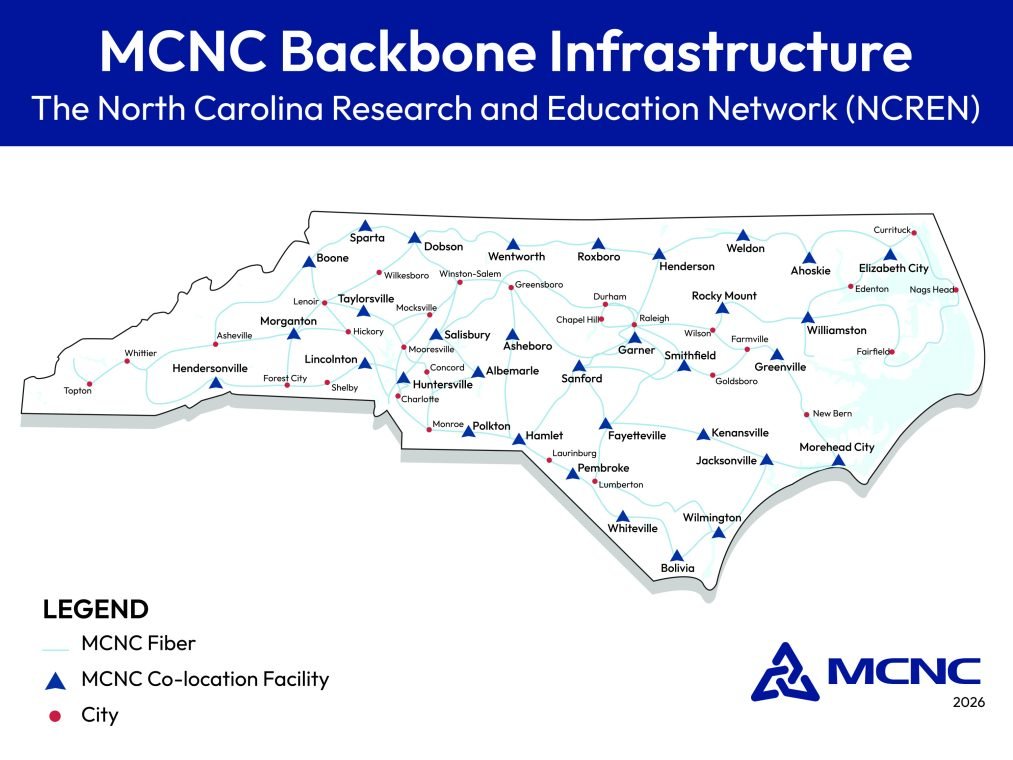
Two fiber routes through the parts of the state that needed them most. The first runs 74 miles from Albemarle to Winston-Salem through central North Carolina. The second runs 135 miles from Sanford through Fayetteville to Jacksonville in the southeast. Together that is 209 new miles of middle-mile fiber, three new telecommunications huts, and access improvements reaching more than 350,000 housing units, nearly 5,000 previously unserved locations, and 696 community anchor institutions such as schools, libraries, hospitals, and public safety agencies across 11 counties.
The funding story is worth knowing too. When the federal Internet for All initiative launched in 2022, more than 235 applications competed nationwide for middle-mile funding, requesting over $5.5 billion. MCNC was the only research and education network in the entire country to win individual funding from the NTIA's middle-mile program. The Golden LEAF Foundation added matching funds, and MCNC invested its own money to finish the job.
| Measure | Figure |
|---|---|
| Total investment | $19 million ($11.19M NTIA, $2.67M Golden LEAF Foundation, $5.1M MCNC) |
| New fiber constructed | 209 miles on two routes: Albemarle to Winston-Salem (74 mi) and Sanford via Fayetteville to Jacksonville (135 mi) |
| Counties directly benefiting | 11, previously home to more than 16,000 unserved and 12,000 underserved housing units |
| Housing units impacted | More than 350,000 |
| Community anchor institutions | 696 schools, libraries, healthcare facilities, and public agencies |
| MCNC network total | 4,745 miles serving all 100 North Carolina counties |
MCNC President and CEO Tracy Doaks called the completion a milestone for making high-speed internet affordable and available across the state, and MCNC COO Tommy Jacobson made a point I think every rural business owner will recognize: the real impact lives in the spaces between towns, where the need for middle-mile infrastructure is greatest. The state's CIO, Nate Denny, tied it directly to education, health care access, and economic growth. They are all describing the same thing from different angles. Fiber in the ground is opportunity that does not wash away.
Why is a Greensboro phone company celebrating MCNC's news?
Because our voice traffic lives on that network. Carolina Digital Phone is an MCNC VoIP partner. One of our three geo-redundant data centers is colocated inside MCNC's Research Triangle Park facility, a Tier 3 data center on the NCREN backbone, and we maintain direct fiber connectivity from MCNC into our downtown Greensboro data center. When a school district in Wilkes County or a county office in Onslow makes a call on our platform, that call can ride private NCREN peering instead of the ordinary public internet.
That arrangement is why we talk about call quality with a straight face. Private peering means lower latency, fewer hops, and voice traffic that never has to fight consumer traffic for the same lane. Every mile MCNC adds makes that foundation stronger, and every telecommunications hut they stand up brings carrier-grade infrastructure closer to communities that used to be a long way from it.
There is a personal side to this as well. I have watched MCNC steward NCREN for decades, back when most people had never heard the word broadband. A nonprofit that puts $5.1 million of its own money into reaching places the market skipped is the kind of partner you want your phone calls riding on.
On the new routes? Let's talk.
If your business, school, or agency is anywhere along the Albemarle to Winston-Salem or Sanford to Jacksonville corridors, your connectivity options just improved. A Carolina Digital Phone engineer can tell you what that means for hosted phone service at your address.
Call (336) 544-4000What does middle-mile fiber mean for your business phones?
A quick translation, because middle mile is one of those terms the industry uses without explaining. Think of internet infrastructure as a highway system. The last mile is the driveway to your building, usually owned by a local internet provider. The middle mile is the highway that driveway connects to. For years, rural North Carolina's problem was not only missing driveways. It was that the highway itself did not come close enough for any local provider to affordably build one.
HERO fixes the highway. MCNC's announcement notes that the expansion now enhances the affordability strategies of last-mile commercial providers in these communities. In plain terms: internet providers in these 11 counties can now reach a world-class backbone nearby, which makes it economical to extend real business-grade service to addresses that never had it.
And once the internet is real, everything we write about on this site becomes available to businesses that were locked out of it:
- Hosted VoIP becomes viable where dial tone used to mean aging copper. A cloud phone system needs dependable internet, and dependable internet is exactly what just arrived. Start with our guide to what hosted VoIP is and how it works.
- Business continuity gets easier. More routes and more huts mean more paths around a failure. Pair that with the failover planning in our business continuity phone guide and a rural office can ride out storms that used to mean silence.
- Schools and agencies gain direct benefits today. The 696 community anchor institutions on these routes connect through the same NCREN network our education and government customers already use, with room-level E911, paging, and the compliance features districts need.
- Remote and hybrid work stops being a city privilege. A softphone app is only as good as the connection under it. Better middle mile means an employee in a small Chatham County town can answer the business line as clearly as one in downtown Raleigh.
A note from someone who has watched this network grow
I have been in North Carolina technology for more than 45 years, and I can tell you the moments that mattered were rarely flashy. They were conduit in the ground, a hut on a rural highway, a route lit for the first time. Towns do not get press conferences for fiber the way they do for factory openings, but the fiber usually comes first and the factory follows.
MCNC was the only research and education network in America to win this funding on its own. That did not happen by luck. It happened because this state has spent decades building institutions that take the unglamorous work seriously. Carolina Digital Phone gets to stand on that work every day, and so does every customer whose calls ride it.
Congratulations to Tracy Doaks, Tommy Jacobson, and the whole MCNC team. The spaces between our towns just got a lot less empty.
Nicky Smith, Founder, Carolina Digital Phone
How Carolina Digital Phone connects your business to this network
For more than 25 years, Carolina Digital Phone has been the trusted local source for telephone, business messaging, and AI Receptionist services across the Carolinas. Our platform runs on three geo-redundant data centers, in downtown Greensboro, in MCNC's Research Triangle Park facility, and in Dallas, with backup power tested weekly and a 99.99 percent uptime target. For schools, colleges, and government agencies, private NCREN peering through MCNC gives voice traffic a managed path built for public institutions.
If the HERO Project just changed what is possible at your address, the next step is a conversation, not a contract. Call (336) 544-4000 and a North Carolina pre-sales engineer will look at your location, your current phone setup, and what the new infrastructure makes possible. Schools and government agencies can reach our dedicated team at (336) 543-0000.
Frequently Asked Questions
What is the HERO Project?
HERO (High-Speed Economies for Rural Opportunity) is a completed $19 million broadband infrastructure project by MCNC that added 209 miles of fiber across 11 rural North Carolina counties on two routes: Albemarle to Winston-Salem and Sanford through Fayetteville to Jacksonville. It was funded by the NTIA, the Golden LEAF Foundation, and MCNC itself.
What is MCNC and what is NCREN?
MCNC is the North Carolina technology nonprofit that builds, owns, and operates NCREN, the North Carolina Research and Education Network. After the HERO Project, the network spans 4,745 fiber miles and provides technology services in all 100 North Carolina counties.
What is middle-mile fiber?
Middle-mile fiber is the high-capacity backbone that connects local internet providers to the wider internet, like a highway that local driveways connect to. When middle mile reaches a rural area, last-mile providers can affordably extend business-grade internet to homes and businesses there.
How is Carolina Digital Phone connected to MCNC?
Carolina Digital Phone is an MCNC VoIP partner. One of our three geo-redundant data centers is colocated in MCNC's Research Triangle Park facility, we maintain direct fiber connectivity from MCNC into our Greensboro data center, and voice traffic for schools and government agencies can ride private peering on the NCREN network.
Does the HERO Project mean my rural business can get hosted VoIP now?
If you are in or near the 11 benefiting counties, very possibly. The new middle-mile fiber makes it economical for local providers to deliver business-grade internet, which is the foundation hosted VoIP needs. Call (336) 544-4000 and an engineer will assess what is available at your specific address.